Heads Up! Netflix Edition
Netflix, Inc.Word
3.748.00 Reviews
- Version
- 1.0.24
- Installs
- 500.00K
- Age Rating
- Everyone
Screenshots
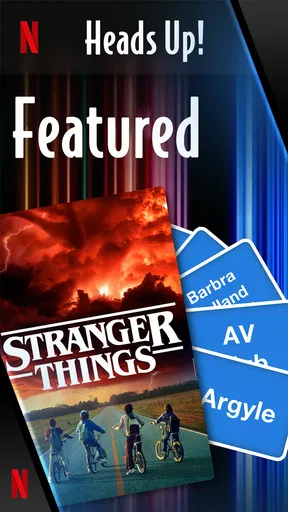

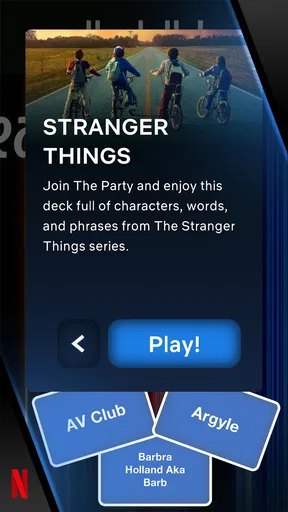
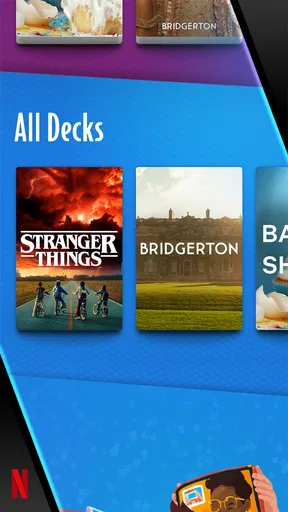
Our Review of Heads Up! Netflix Edition
 Analysis by Appyee
I spent time with Heads Up! Netflix Edition as a quick party game rather than as a long-form word challenge, and that distinction matters. Its appeal is immediate: one person tries to guess while another gives clues, creating short bursts of noise, laughter, and pressure. The game belongs to the word category, comes from Netflix, Inc., and is free to play, so it is easy to consider when you need something for a group without asking everyone to buy in first.
What I like most is how little preparation it demands. You do not need to explain a complicated ruleset before starting, and the basic idea is familiar enough for new players to join quickly. At the same time, the experience is not equally strong for every kind of player. If you want a quiet solo word puzzle, a detailed campaign, or a carefully balanced competitive ladder, this is probably the wrong direction. If you want a fast guessing game that can fill an awkward pause at a gathering, it makes much more sense.
How the guessing loop creates its own goals
I found that the loop gives a group a natural reason to keep playing without needing a formal score chase: each round invites a small improvement in timing, clue choice, or teamwork. That makes it useful for households sharing one device, where people can join briefly and hand over the guessing role rather than needing separate accounts or lengthy setup. The next question is how to make that shared session comfortable for everyone.
The first goal is simply to keep the round moving
My first few rounds made the main objective clear: recognize the clue quickly, communicate without saying the answer outright, and avoid letting hesitation drain the energy from the group. That sounds simple, but the time pressure changes how people behave. A clue that would be obvious in a relaxed conversation can become surprisingly difficult when the guesser is watching the clock and the clue-giver is trying several explanations at once.
This gives the game an early goal that does not need a separate mission screen or a long tutorial. You are trying to build a rhythm. The guesser needs to trust the clue-giver, while the clue-giver needs to learn which descriptions work for that particular person. With friends, this becomes more interesting after only a few turns because you start noticing personal habits: who relies on gestures, who gives overly broad hints, and who panics when the first explanation fails.
I found this more engaging than a standard turn-based word puzzle when several people were present. Traditional word games often reward careful thinking in silence, but this one rewards shared timing. It is less about finding the perfect answer alone and more about making a whole group react at once. That makes the early experience accessible, although it also means the fun depends heavily on the people around you.
Small improvements become visible through play
The most useful progress signal is not a large collection of statistics. It is the way a group gradually gets better at the format. After a few rounds, players tend to shorten their clues, abandon unhelpful explanations sooner, and understand each other’s shortcuts. I could feel this change even when the game itself was not presenting a traditional character progression path.
That is an important distinction for anyone wondering whether there are meaningful unlocks. I would not approach this as a game built around a deep advancement system. Its sense of progress comes mainly from improving your performance and finding a better group rhythm. If you are expecting new abilities, a campaign map, or a substantial reward structure to open over time, the experience may feel light.
There is still a satisfying reason to replay a category or return after a break: you can try to beat the mood and performance of an earlier session. I especially liked using a strong player as the first guesser, because that person demonstrates the pace without turning the opening round into a confusing free-for-all. Newer players can then copy the style of clues that worked.
Use the game as a social warm-up, not the entire evening
A realistic use case is a small gathering where conversation has stalled. Someone opens the game, one person takes the guessing role, and the rest of the group immediately has a reason to participate. The app works well here because the explanation can be delivered while people are already preparing to play. I would use it before a longer board game, during a family visit, or as a five-minute activity while waiting for food.
My practical tip is to avoid making the first round overly competitive. Let the group learn the pace and the acceptable style of clues before worrying about who performed best. This matters because a nervous player can make the game seem harder than it is. Once people understand that a failed clue is part of the comedy, the atmosphere improves considerably.
Another useful approach is to rotate the clue-giver often. One confident person can carry a round, but allowing everyone to give clues reveals whether the group enjoys the communication challenge or only enjoys watching one particularly expressive player. That small change also prevents the game from becoming repetitive too quickly.
The difficulty curve comes from people more than from levels
The challenge does not feel like a conventional staircase where each stage introduces a clearly tougher enemy or puzzle. Instead, difficulty rises through context. A familiar word can be easy for one group and nearly impossible for another. A clue-giver who knows the guesser well may make a difficult prompt feel simple, while strangers may struggle with something that appears obvious.
This flexible difficulty is one of the game’s strengths at a party. Children, adults, experienced players, and complete newcomers can often share the same session because the group naturally adjusts its clue style. The Everyone age rating also fits that broad, casual positioning. Still, the same flexibility can make the challenge feel inconsistent if you are looking for precise competitive balance.
I would not recommend judging the game by whether every round feels equally fair. That is not really its personality. The best moments often come from uneven knowledge, accidental misunderstandings, and a clue that sends everyone in the wrong direction. Players who prefer exact rules and measurable mastery may find that looseness frustrating rather than entertaining.
What makes a round easy can also make it less memorable
The accessible structure lets people begin quickly, but it can reduce the feeling of discovery for players who already know this type of guessing game. There is no need to spend time learning a complex strategy, which is excellent for casual use, yet it also means the game has less room to surprise a dedicated word-game fan.
That trade-off shaped my opinion. I enjoyed it most when I treated each session as a social activity rather than a personal test. When I tried to analyze it as a serious progression game, the limited depth became more noticeable. The game’s challenge is strongest in the moment, during the scramble to describe and guess, not in a long-term system that keeps unfolding.
Pacing is the feature that decides whether it works
The fast pace is not just a label; it determines the entire experience. A good round creates a chain of quick decisions: speak, listen, guess, recover, and move on. That momentum keeps quiet moments from lasting too long. It also means that a group can fit several turns into a short break without committing to a full evening.
However, fast play places demands on the room. If people are talking over the clue-giver, if the phone is difficult to see, or if participants are distracted, the pressure stops feeling exciting and starts feeling messy. I recommend choosing one person to manage the device and making sure the guesser can focus on it without having to pass it around constantly.
For a family setting, I would also establish a simple rule before beginning: clues should help rather than deliberately confuse. That keeps the game welcoming for younger or less experienced players. For a group of competitive friends, the opposite may be entertaining, but the app itself cannot solve a mismatch in expectations between players.
Does it create retention pressure?
The game can encourage another round because each turn ends quickly and the group usually wants to improve the next attempt. That is a healthy kind of retention for this format: people continue because the room is having fun, not because they need to complete a large checklist. I found that the desire to replay came from unfinished social momentum, especially after a funny mistake or a near-successful guess.
At the same time, the experience may lose force if you play continuously with the same small group. Because the core loop is so direct, its freshness depends on changing the people, mood, or setting. A new participant can make familiar play feel different, while repeating the same routine without a break can expose the limited depth.
This is where the Netflix connection is useful in practical terms. The game is free, and its presence in Netflix’s game collection makes it an easy title to try for subscribers who are already looking for something casual. I would not install it expecting a large standalone word-game ecosystem. I would install it as a convenient option for moments when a group needs an activity immediately.
Who should choose it, and who should skip it?
I think it is a good fit for friends who enjoy expressive party games, families wanting a simple shared activity, and people who prefer short sessions over lengthy strategic play. It also works for hosts who want a backup game that does not require a table full of pieces or a long rules explanation.
I would be more cautious if you mainly play alone. The central pleasure comes from the interaction between the guesser and the clue-giver, so solo use does not represent the game at its best. I would also point serious word-game enthusiasts toward a more structured alternative if they want vocabulary depth, carefully tuned difficulty, or a progression system that rewards repeated individual practice.
Compared with a conventional crossword or daily word puzzle, this is louder, faster, and more dependent on communication. Compared with a traditional party game, it is easier to start but may offer less strategic variety. Compared with a word quiz, it relies less on stored knowledge and more on how creatively people can explain something under pressure. Those differences make it complementary rather than a replacement for every other game in the category.
Practical details before installing
The game is free, carries an Everyone content rating, and requires Android nine or later. Those details make it a fairly approachable choice for households with different devices, although the actual quality of a session will still depend on how comfortably the group can gather around the phone.
Netflix, Inc. released it on August 18, 2022, and the current version is 1.0.24. Its reach is substantial, with over half a million installs, while the average rating sits at 3.7 from roughly 881 ratings and 48 written reviews. I read that combination as a sign of a game with a clear audience but a somewhat uneven reception: many people can understand the appeal immediately, yet not everyone will want a simple social loop as a regular game.
Those figures should not replace your own expectations. A rating is less useful here than asking whether you have the right setting. If you have two people who enjoy giving clues and guessing, the game can be lively. If you are downloading it for a solitary commute, a conventional word puzzle is likely to serve you better.
My progression verdict
My final view is that the game sustains play through short-term goals, group improvement, and quick comic payoffs rather than through a deep unlock structure. You begin by trying to get through a round, then start refining your clue style, and finally decide whether the group wants another attempt. That is enough to support repeat sessions when the social situation is right.
The limitation is equally clear: the app’s long-term pull is modest if you remove the group. I would not buy into it as a serious progression experience, and I would not expect a carefully escalating challenge curve. Its best use is targeted and practical: open it when people are together, keep the rounds moving, rotate roles, and stop while the energy is still good.
For me, that makes Heads Up! Netflix Edition an easy recommendation for casual gatherings, with one condition: choose it for the interaction, not for a rich solo system. It is at its best when the goal is to make people talk, react, and laugh quickly. If that is what you need, the straightforward design is a strength. If you need lasting individual progression, another word game will be a better companion.
Verdict
Strengths of Heads Up! Netflix Edition
- Simple rules make it easy for anyone to start playing.
- Large variety of themed decks keeps repeat sessions entertaining.
- Supports group play, making it ideal for parties and family gatherings.
- Video recording captures memorable guesses and reactions.
- Netflix access is included, with no separate purchase for the game.
Limitations of Heads Up! Netflix Edition
- Requires an active Netflix membership to access the game.
- Playing comfortably usually requires another person to hold the phone.
- Some decks may feel repetitive after frequent use.
- Background noise can make clues and guesses difficult to hear.
- Limited appeal for users who prefer solo or strategy-focused games.
Other Releases by Netflix, Inc.
View All
Netflix
Entertainment4.8

Sonic Mania Plus - NETFLIX
Action4.5

Bloons TD 6 NETFLIX
Strategy4.6

Football Manager 26 Mobile
Sports4.3
Similar Picks in This Category
View All
Word Search - Word Puzzle Game
Bluetile4.8

Word Search Quest - Puzzles
Blackout Lab4.8

CodyCross: Crossword Puzzles
Fanatee, Inc.4.7

Words of Wonders: Crossword
Fugo Games4.9

Wordscapes: Word puzzle game
PeopleFun4.7

Word Search Explorer
PlaySimple Games4.9
Frequently Asked Questions
What is Heads Up! Netflix Edition?
Heads Up! Netflix Edition is a party word-guessing game based on the popular Heads Up! format. One player holds the phone against their forehead while teammates give clues to help guess the word or phrase on screen. This Netflix version includes themed decks and is designed for quick, social rounds at gatherings, family events, and casual game nights.
Do I need a Netflix subscription to play Heads Up! Netflix Edition?
Yes, access to Heads Up! Netflix Edition generally requires an active Netflix membership. Players typically sign in through the Netflix app or with their Netflix account before starting the game. Availability can depend on the country, account type, device, and current Netflix policies, so it is worth checking the app listing and ensuring your subscription is active before downloading.
How many people can play the game?
The game is intended for two or more people, although it becomes more entertaining with a larger group. One person acts as the guesser and the others provide clues, then players can rotate roles between rounds. Since the game relies on spoken hints rather than online matchmaking, everyone usually plays together in the same room using one phone.
What types of decks and categories are included?
Heads Up! Netflix Edition offers themed word and phrase decks designed around different subjects and styles of play. The exact selection may vary by region or change with updates, but players can generally expect categories suited to entertainment, everyday topics, and group challenges. Before downloading, review the current store description because available decks and content can be updated.
Is Heads Up! Netflix Edition suitable for children and family game nights?
It can be a fun family game, but suitability depends on the selected deck and the age of the players. Some categories may include references, vocabulary, or humor aimed at older audiences. Parents should review the game’s age rating and available content, especially when younger children are playing. The simple controls make it easy to learn, while adult supervision can help choose appropriate categories.
Play our best games!


